Build vs. Perform: The Benefits of Having Two Functional Fitness Training Tracks
Here at R3VIVE, we believe in directing you on the best path toward your specific goals. One of the major problems with group classes is that they are programmed for the general population and thus are not personalized. Even though the coaches modify the day’s workout for you based on your ability level or goals, the programming is still not very specific to you. The traditional answer for creating a more specific plan is to hire a personal trainer. While we believe that personal training is the most efficient way to attain your fitness goals, we wanted to create a way that addressed the lack of individualized programming in group functional fitness classes.
Our solution was to include two tracks – Build and Perform – in all of our functional fitness classes. These two different tracks always run together in each class and allow us to direct each athlete to the track that will best help them achieve their goals or needs. We still modify for each individual, but we start from a different prescription rather than employing a one-size-fits-all approach. This allows us to create an environment that supports our members’ progress in their health and fitness journey, allowing them to explore different variations or paths based on their current life stage or goals.
Some members might be seeking to enhance their top-end strength, improve their aerobic capacity, and acquire new and more complex skills, while others may simply aim to consistently build their baseline strength, maintain lifelong health, look good, and feel good. The use of separate tracks helps us guide our members in the direction that best aligns with their specific goals. Neither track is inherently superior or inferior; they are highly interchangeable, allowing our coaches to create a diverse and effective environment. The two tracks allow us to build a large and diverse community of gym members who are looking to improve their health and fitness and support one another.
What is Build?
Our Build track focuses on building a solid foundation in both strength and conditioning for the long term. Each training cycle prioritizes the development of movement pattern strength and competency instead of exercise-specific movements. What that means is that you will be doing a larger variety of exercises to build muscle and strength across various muscle groups. For example, if we want to improve our back squat strength, we might alternate movements, such as back squats, goblet squats, box step-ups, etc. This will improve our lower body pushing strength, not just our overall squat strength.
In addition to strength, we also focus on more sustainable conditioning to improve our cardiovascular system. Keeping the exercises simple allows us to focus on building an aerobic base without worrying about a more complex exercise or skill. This allows us to progressively improve our strength and conditioning base over time.
What is Perform?
The Perform track aims to build our top-end strength and conditioning, focusing on improving our maxes in exercises such as squats, cleans, strict press, etc. Simultaneously, we work towards improving our conditioning through tests, such as 1-mile run, 500m row, or other aerobic benchmarks. To do this, our Perform training cycles focus on exercise-specific training to improve strength. This involves progressively increasing weights or reps for a particular exercise on a weekly basis, creating a progressive overload to improve our strength. For example, when building squat strength, week one might feature 3 sets of 5 front squats at 65%, 75%, and 85% of our 1 Rep Max. In week two, we would perform 3 sets of 3 front squats at 70%, 80%, and 90%, continuing this progression for several weeks.
Our aerobic development not only focuses on building a solid conditioning base but also integrates more complex lifts (such as cleans and snatches) and higher-level gymnastics (such as kipping pull-ups, toes to bar, or chest to bar pull-ups) into the workouts. In Perform track, expect moderate to tough weights and a greater variety of exercises during the conditioning pieces in order to increase movement competency and add more variety to the training.
The Differences between Build and Perform
The main difference between the Perform and Build tracks is intent. Both tracks focus on strength and conditioning, but they target different end goals. Perform aims to improve strength by building and increasing our 1 or 3 rep max strength numbers for specific exercises, such as squats or cleans, while Build seeks to build muscle mass and baseline strength through a variety of movements and higher volumes.
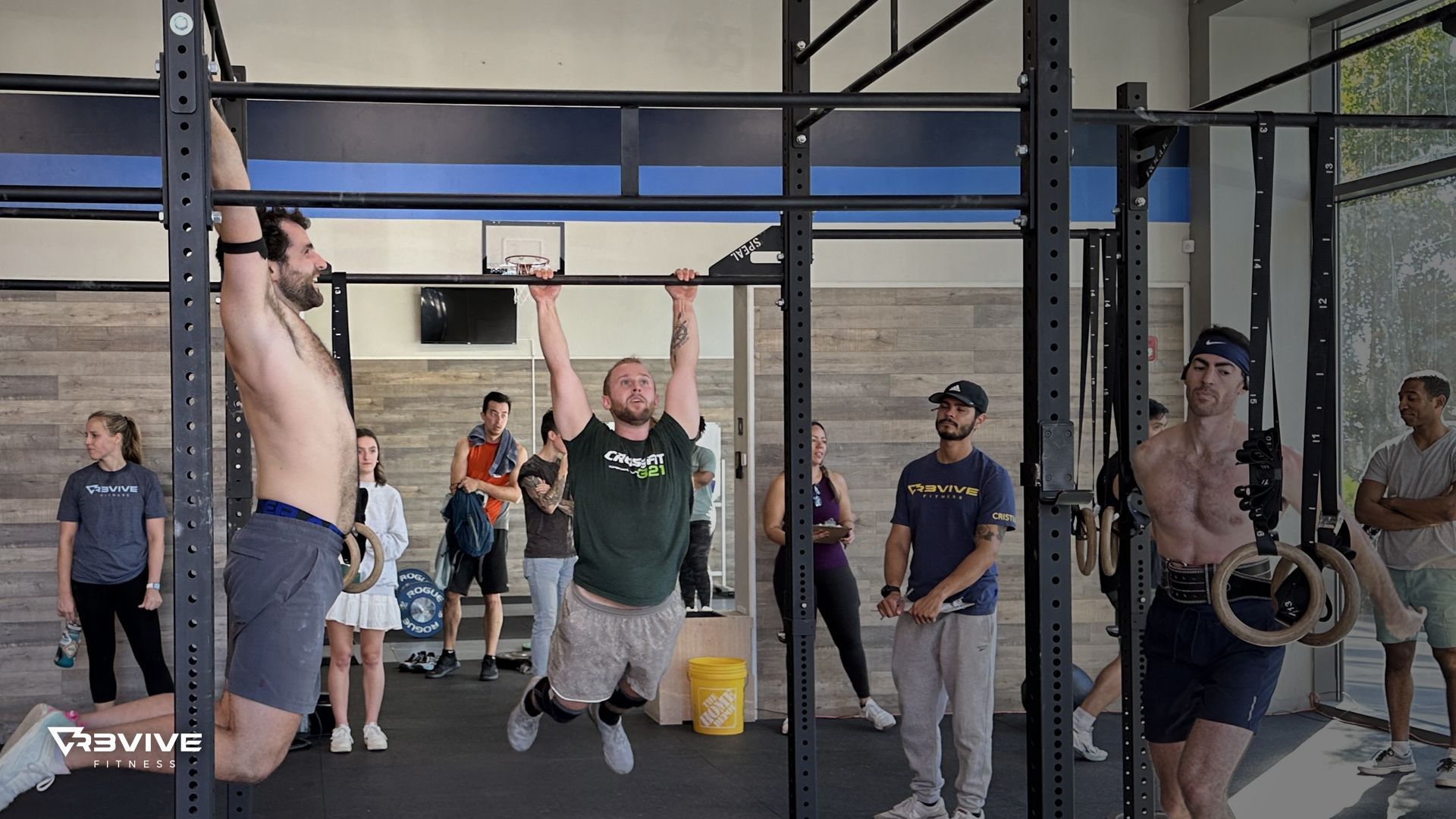
Perform also incorporates the practice and training of higher-level gymnastics and more complex lifts such as clean & jerks, snatches, kipping pull-ups, toes to bar, chest to bar, and maybe even muscle-ups in order to help build power and spatial awareness. Build sticks with more strict gymnastics, bodybuilding/accessory exercises, and basic compound movements, such as strict pull-ups, push-ups, deadlifts, squats, bicep curls, hamstring curls, etc. This approach helps build strength in a variety of movements while also promoting muscle growth and maintaining joint health for the long term.
Conditioning for Perform integrates some of the more complex lifts and higher-level gymnastic skills into higher intensity conditioning pieces. This allows athletes to improve both their conditioning and their ability to move through complex situations or handle heavier loads at higher heart rates. Perform focus on building overall speed across different time domains and modalities, aiming to both enhance explosiveness and improve longer aerobic work over time.
Build, in contrast, concentrates on sustainable efforts across various time domains, incorporating less complex exercises at more moderate loads. The goal is to move at a smooth pace through each specific workout, to achieve the intent of that specific workout. This will help us build a solid aerobic base to support activities outside the gym.
How to choose the right fitness track
When choosing which track best fits you for that day or training cycle, you’ll want to ask yourself a few questions. Just remember there is no one right answer and we can mix and match based on your needs and goals.
- What is my overall fitness goal, or what am I trying to accomplish today?
- Am I looking to build top-end strength and conditioning? Choose Perform. Am I looking to build more muscle mass and my base strength and conditioning? Choose Build.
- Do my goals align more with a particular track?
- How experienced am I with training or the movements on this day?
- If you are unfamiliar with a movement or exercise, choosing build might be the better choice since the learning curve will be smaller and you can work towards heavier loads or the correct intensity more easily and safely.
- If you’re ok with being unfamiliar and wanting to spend time on those new exercises, Perform may be the better choice. You will be spending most of your time learning that movement and not necessarily pushing strength or conditioning improvements that day, but instead learning a new skill for a later day.
- How is my body feeling today?
- If you’re feeling beat up and you normally do Perform, you should choose Build and focus on quality and not intensity that day.
- Build is not easier than Perform. It allows for more focus since the movements are less complex, and can give all members significant benefits.
Remember you never have to do just one or the other. These tracks are interchangeable and will support one another.
If you have any questions or are not sure yourself, you can always ask a coach. Our coaches are there to help you on your journey to your fitness goals and lead you during class. You can also reach out to us after class if you want a more specific discussion on what might be best for you.
The post Build vs. Perform: The Benefits of Having Two Functional Fitness Training Tracks appeared first on R3VIVE FITNESS.